
Cult of Sea

Maritime Knowledge base

  • Home
  • Knowledge base
    • Bridge Equipment
    • Cargo Work
    • Deck
    • General
    • Gmdss
    • Maritime Law
    • Marpol
    • MLC 2006
    • Meteorology
    • Navigation
    • Safety
    • Security
    • Ship Construction
    • Ship Handling
    • Ship Stability
    • Shippie’s Escape
    • Surveys
    • Tankers
  • Colreg’s (ROR)
    • Index (Colreg’s)
    • Part A- General
      • Rule 1 – Application
      • Rule 2 – Responsibility
      • Rule 3 – General Definitions
    • Part B- Steering and Sailing
      • Section 1 (Rule 4 -10)
        • Rule 4 – Application
        • Rule 5 – Lookout
        • Rule 6 – Safe Speed
        • Rule 7 – Risk of collision
        • Rule 8 – Action to avoid collision
        • Rule 9 – Narrow Channels
        • Rule 10 – Traffic separation schemes
      • Section 2 (Rule 11 – 18)
        • Rule 11 – Application
        • Rule 12 – Sailing vessels
        • Rule13 – Overtaking
        • Rule 14 – Head on situation
        • Rule 15 – Crossing situation
        • Rule 16 – Action by give-way vessel
        • Rule 17 – Action by stand-on vessel
        • Rule 18 – Responsibilities between vessels
      • Section 3 (Rule 19)
        • Rule 19 – Conduct of vessels in restricted visibility
    • Part C- Lights and Shapes
      • Rule 20 – Application
      • Rule 21- Definitions
      • Rule 22 – Visibility of lights
      • Rule 23 – Power-driven vessels underway
      • Rule 24 – Towing and pushing
      • Rule 25 – Sailing vessels underway and vessels under oars
      • Rule 26 – Fishing vessels
      • Rule 27 – Vessels N.U.C or R.A.M
      • Rule 28 – Vessels constrained by their draught
      • Rule 29 – Pilot vessels
      • Rule 30 – Anchored vessels and vessels aground
      • Rule 31 – Seaplanes
    • Part D- Sound and Light Signals
      • Rule 32 – Definitions
      • Rule 33 – Equipment for sound signals
      • Rule 34 – Manoeuvring and warning signals
      • Rule 35 – Sound signals in restricted visibility
      • Rule 36 : Signals to attract attention
      • Rule 37 – Distress signals
    • Part E- Exemptions (Rule 38)
      • Rule 38 – Exemptions
    • Part F – Verification of compliance with the provisions of the Convention
      • Rule 39 – Definitions
      • Rule 40 – Application
      • Rule 41 – Verification of compliance
    • Annexes
      • Annex 1 – Positioning and technical details of lights and shapes
      • ANNEX II – Additional Signals for Fishing Vessels Fishing in Close Proximity
      • ANNEX III – Technical Details of Sound Signal Appliances
      • ANNEX IV – Distress Signals
  • Glossary
  • Contact
You are here: Home / General / Using Magnetic compass in Polar Regions

Using Magnetic compass in Polar Regions

Why is magnetic compass useless in higher latitude or Polar Regions?

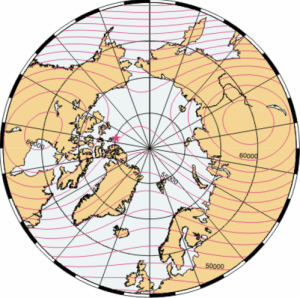
The magnetic compass depends on the horizontal component of the magnetic field of the earth. As the north magnetic pole is approached in the Arctic, the horizontal component becomes progressively weaker until at same point. The magnetic compass becomes useless as a direction measuring device.

The magnetic compass will not settle unless the ship remains on the same heading for a prolonged period, so it can be considered almost useless anywhere north of Lancaster Sound.

So is it possible to use a magnetic compass in higher latitude?

The answer is Yes, If the compass must be used the error should be checked frequently by celestial observation and, as the rate of change of variation increases as the pole is approached, reference must be made to the variation curve or rose on the chart.

It’s risky, then what equipment is required for vessels navigating north of 60° North latitude?

  • Two radars;
  • Two Gyro compasses;
  • Two echo sounders, each with an independent transducer Two searchlights with two spare lamps;
  • A weather facsimile receiver; and A spare antenna.

What projection is used in the Arctic?

In the Arctic, the common projections are Lambert Conformal Conic, Polyconic, and Polar Stereographic. Polar Stereographic is popular as it provides minimum distortion over relatively large areas.
 

Related:

  • Magnetic Compass & Ship Magnetism - Simplified Explanation
  • Circumpolar bodies
  • Technical Aspects of GMDSS Equipments - Propagation,…
  • BLU Code - Code Of Practice For The Safe Loading And…
  • Ship's Magnetic Compass - Dry and Wet Compass with…
  • Gyro Compass - Basic Principle, Operation and Usage on Ships

By Capt. Angad S Cheema Filed Under: General, Navigation Tagged With: arctic, General, lambert, magnetic compass, polar, polar stereographic, polyconic, projection

Comments

  1. David Boffey says

    August 20, 2022 at 6:39 am

    “It’s risky, then what equipment is required for vessels navigating north of 60° North latitude?
    Two radars;
    Two Gyro compasses;”
    Gyurocompasses are also pretty useless in high latitudes.

    Reply

Leave a Reply Cancel reply

Your email address will not be published. Required fields are marked *

mariner-gps
Sail Time
Simple Colregs COS Ad

Join Our List

Subscribe to our mailing list and get interesting stuff and updates to your email inbox.

Powered with ♥ by Cult of Sea

instagram-button

What others are reading

Gangway Watchman

Duties of Gangway Watchman – Merchant Ships

Immersion Suit

knots

Types of Knots, Bends and Hitches used at sea

Combustible Gas Indicator or (Explosimeter) – Tanker Instruments

longitudinal-stability

Longitudinal Stability for Ships

Passage Planning

Passage Planning

Harmonized System of Survey and Certification

Harmonized System of Survey and Certification (HSSC)

Regulation 15

Control of operational discharge of oil (Machinery Spaces)

I haven’t been everywhere, but it’s on my list

Annex

ANNEX II – Additional Signals for Fishing Vessels Fishing in Close Proximity

Ship Anchor

Anchor Terminology used in Shipping

Cargo Conditioning, Reliquefaction – Gas Tankers

Revised High Risk Area – BMP4 effective 1 December 2015

Pi-club

Protection & Indemnity Clubs

Part C Lights and Shapes

Rule 20 – Application


About Us | Terms | Contact Us | Sitemap | Marine Glossary (BETA)

Cult of Sea®™ · Made with ❤ by a small band of sailors