Cult of Sea

Maritime Knowledge base

  • Home
  • Knowledge base
    • Bridge Equipment
    • Cargo Work
    • Deck
    • General
    • Gmdss
    • Maritime Law
    • Marpol
    • MLC 2006
    • Meteorology
    • Navigation
    • Safety
    • Security
    • Ship Construction
    • Ship Handling
    • Ship Stability
    • Shippie’s Escape
    • Surveys
    • Tankers
  • Colreg’s (ROR)
    • Index (Colreg’s)
    • Part A- General
      • Rule 1 – Application
      • Rule 2 – Responsibility
      • Rule 3 – General Definitions
    • Part B- Steering and Sailing
      • Section 1 (Rule 4 -10)
        • Rule 4 – Application
        • Rule 5 – Lookout
        • Rule 6 – Safe Speed
        • Rule 7 – Risk of collision
        • Rule 8 – Action to avoid collision
        • Rule 9 – Narrow Channels
        • Rule 10 – Traffic separation schemes
      • Section 2 (Rule 11 – 18)
        • Rule 11 – Application
        • Rule 12 – Sailing vessels
        • Rule13 – Overtaking
        • Rule 14 – Head on situation
        • Rule 15 – Crossing situation
        • Rule 16 – Action by give-way vessel
        • Rule 17 – Action by stand-on vessel
        • Rule 18 – Responsibilities between vessels
      • Section 3 (Rule 19)
        • Rule 19 – Conduct of vessels in restricted visibility
    • Part C- Lights and Shapes
      • Rule 20 – Application
      • Rule 21- Definitions
      • Rule 22 – Visibility of lights
      • Rule 23 – Power-driven vessels underway
      • Rule 24 – Towing and pushing
      • Rule 25 – Sailing vessels underway and vessels under oars
      • Rule 26 – Fishing vessels
      • Rule 27 – Vessels N.U.C or R.A.M
      • Rule 28 – Vessels constrained by their draught
      • Rule 29 – Pilot vessels
      • Rule 30 – Anchored vessels and vessels aground
      • Rule 31 – Seaplanes
    • Part D- Sound and Light Signals
      • Rule 32 – Definitions
      • Rule 33 – Equipment for sound signals
      • Rule 34 – Manoeuvring and warning signals
      • Rule 35 – Sound signals in restricted visibility
      • Rule 36 : Signals to attract attention
      • Rule 37 – Distress signals
    • Part E- Exemptions (Rule 38)
      • Rule 38 – Exemptions
    • Part F – Verification of compliance with the provisions of the Convention
      • Rule 39 – Definitions
      • Rule 40 – Application
      • Rule 41 – Verification of compliance
    • Annexes
      • Annex 1 – Positioning and technical details of lights and shapes
      • ANNEX II – Additional Signals for Fishing Vessels Fishing in Close Proximity
      • ANNEX III – Technical Details of Sound Signal Appliances
      • ANNEX IV – Distress Signals
  • Glossary
  • Contact

Stresses in Ships

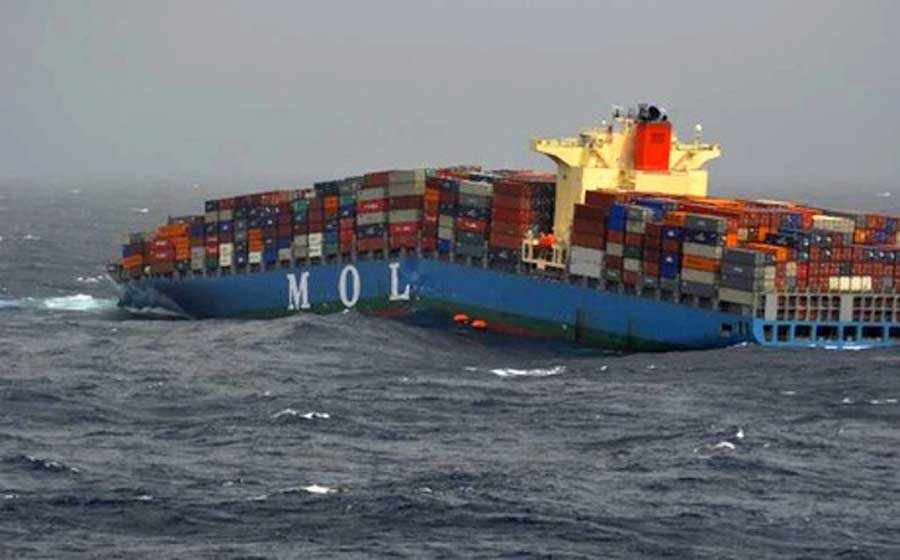
A ship at sea is subjected to a number of forces causing the structure to distort. Initially, these may be divided into two categories, as follows:Static forces - Ship floating at rest in still water.Two major forces acting:the weight of the ship acting vertically down buoyancy acting upDynamic forces - due to the motion of the ship and the sea the structural stresses, caused by the above forces, to which the ship structure is subjected may be categorized as:Longitudinal stresses (hogging and sagging) Transverse stresses (racking and the effects of water … [Read more...]

By Capt. Angad S Cheema Filed Under: Ship Construction Tagged With: drydocking stresses, dynamic forces, dynamic stresses, hogging, localised, longitudinal stresses, panting, pounding, racking, sagging, Ship Construction, static forces, strain guages, stress, Torsion, transverse stresses, water pressure, whipping, whipping stresses

mariner-gps
Sail Time
Simple Colregs COS Ad

Join Our List

Subscribe to our mailing list and get interesting stuff and updates to your email inbox.

Powered with ♥ by Cult of Sea

instagram-button

What others are reading

Search Procedures & Stores Checks

Search Procedures & Stores Checks – ISPS (Merchant Ships)

Revised High Risk Area – BMP4 effective 1 December 2015

lifejacket

SOLAS REQUIREMENT’s FOR LIFEJACKET

Single Point Mooring Operation

SPM (Single Point Mooring) or SBM Operations

Tanker Terminology used in Shipping

Ship's Waterplane, Block, Midship and Prismatic Coefficient

Coefficients of Form – Ship’s Waterplane, Block, Midship and Prismatic Coefficient

Weather-Fronts

Frontal Depressions – Types of Fronts, Weather Associated and Frontolysis

intact stability

Intact Stability – Tankers

stowaways

Stowaways – Who are they, What are Individual Duties?

The Inclining Experiment

The Inclining Experiment – Ascertain the GM of Vessel

Condition Assessment Scheme (CAS)

Condition Assessment Scheme (CAS)

Bridge Navigational Watch Alarm System (BNWAS)

Blu code

BLU Code – Code Of Practice For The Safe Loading And Unloading Of Bulk Carriers

longitudinal-stability

Longitudinal Stability for Ships

Glossary of Terms – Petroleum Cargo Calculations


About Us | Terms | Contact Us | Sitemap | Marine Glossary (BETA)

Cult of Sea®™ · Made with ❤ by a small band of sailors