Cult of Sea

Maritime Knowledge base

  • Home
  • Knowledge base
    • Bridge Equipment
    • Cargo Work
    • Deck
    • General
    • Gmdss
    • Maritime Law
    • Marpol
    • MLC 2006
    • Meteorology
    • Navigation
    • Safety
    • Security
    • Ship Construction
    • Ship Handling
    • Ship Stability
    • Shippie’s Escape
    • Surveys
    • Tankers
  • Colreg’s (ROR)
    • Index (Colreg’s)
    • Part A- General
      • Rule 1 – Application
      • Rule 2 – Responsibility
      • Rule 3 – General Definitions
    • Part B- Steering and Sailing
      • Section 1 (Rule 4 -10)
        • Rule 4 – Application
        • Rule 5 – Lookout
        • Rule 6 – Safe Speed
        • Rule 7 – Risk of collision
        • Rule 8 – Action to avoid collision
        • Rule 9 – Narrow Channels
        • Rule 10 – Traffic separation schemes
      • Section 2 (Rule 11 – 18)
        • Rule 11 – Application
        • Rule 12 – Sailing vessels
        • Rule13 – Overtaking
        • Rule 14 – Head on situation
        • Rule 15 – Crossing situation
        • Rule 16 – Action by give-way vessel
        • Rule 17 – Action by stand-on vessel
        • Rule 18 – Responsibilities between vessels
      • Section 3 (Rule 19)
        • Rule 19 – Conduct of vessels in restricted visibility
    • Part C- Lights and Shapes
      • Rule 20 – Application
      • Rule 21- Definitions
      • Rule 22 – Visibility of lights
      • Rule 23 – Power-driven vessels underway
      • Rule 24 – Towing and pushing
      • Rule 25 – Sailing vessels underway and vessels under oars
      • Rule 26 – Fishing vessels
      • Rule 27 – Vessels N.U.C or R.A.M
      • Rule 28 – Vessels constrained by their draught
      • Rule 29 – Pilot vessels
      • Rule 30 – Anchored vessels and vessels aground
      • Rule 31 – Seaplanes
    • Part D- Sound and Light Signals
      • Rule 32 – Definitions
      • Rule 33 – Equipment for sound signals
      • Rule 34 – Manoeuvring and warning signals
      • Rule 35 – Sound signals in restricted visibility
      • Rule 36 : Signals to attract attention
      • Rule 37 – Distress signals
    • Part E- Exemptions (Rule 38)
      • Rule 38 – Exemptions
    • Part F – Verification of compliance with the provisions of the Convention
      • Rule 39 – Definitions
      • Rule 40 – Application
      • Rule 41 – Verification of compliance
    • Annexes
      • Annex 1 – Positioning and technical details of lights and shapes
      • ANNEX II – Additional Signals for Fishing Vessels Fishing in Close Proximity
      • ANNEX III – Technical Details of Sound Signal Appliances
      • ANNEX IV – Distress Signals
  • Glossary
  • Contact

SPM (Single Point Mooring) or SBM Operations

Single Point Mooring Operation

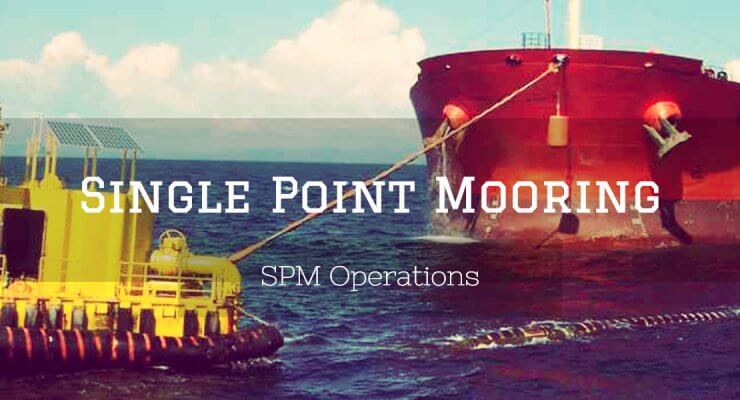
A Single Point Mooring Buoy consists of a buoy that is permanently moored to the seabed by means of multiple mooring lines/anchors/chains allowing cargo transfer of liquid petroleum products. The buoy contains a bearing system that allows a part of it to rotate around the moored geostatic part. When a Ship is moored to this rotating part of the buoy with a mooring connection, the vessel is able to freely weather-vane around the geostatic part of the buoy. Responsibility Master has the overall responsibility for the mooring operations of the vessel at the SBM.The officer-in-charge of … [Read more...]

By Capt. M.G Mirji Filed Under: Tankers Tagged With: anchor, breakaway hose, calm, calm buoy mooring, catenary, floating hose, mooring, plem, ppe, salm, sbm, single point, single point mooring, spm

Using Toggle Pin

Toggle Pin

HOW TO USE A TOGGLE PIN 1. Shackle the Toggle-pennant to the mooring bitts.2. Run the messenger ( with a small eye spliced in the end ) from winch to the mooring line to be released. 3. Take the messenger and make a turn around the mooring line.4. Pass a bight of the messenger through the eye.5. Pass the Toggle through this bight.6. Heave in on the Messenger rope.  7. Remove mooring lines from the bitts.  8. Slack the messenger line, the toggle will release itself and the messenger will be freed and the … [Read more...]

By Capt. Angad S Cheema Filed Under: Deck Tagged With: deck, messenger, messenger rope, mooring, ship, toggle, toggle pin

mariner-gps
Sail Time
Simple Colregs COS Ad

Join Our List

Subscribe to our mailing list and get interesting stuff and updates to your email inbox.

Powered with ♥ by Cult of Sea

instagram-button

What others are reading

Echo Sounder

Echo Sounder – Principle, Working & Errors

Gangway Watchman

Duties of Gangway Watchman – Merchant Ships

Vegetable, Palm and Soybean/Sunflower Oils – Carriage on Tankers

Formal Safety Assessment Cover

Formal Safety Assessment (FSA) – Guidelines for use in IMO Rule Making Process

Part B - Section 1

Rule 10 – Traffic separation schemes

Visual Storm (Cyclone) Warning Signals for Indian Sea Ports

International Maritime Organization or IMO: what it is, what it does and how it works ?

Using Magnetic compass in Polar Regions

Part D - Sound and Light Signals

Rule 36 : Signals to attract attention

SART

What is SART – Search and Rescue Radar Transponder?

Guidelines on Working aloft or Overside on Ships

Combustible Gas Indicator or (Explosimeter) – Tanker Instruments

OIL TANKER OPERATIONS (Discharging) – Conventional Tanker Basics

Propeller Cavitation

Propeller Cavitation Explained – Cause, Types, Effects & Avoidance

Precautions while Entering and Navigating within Ice Limits


About Us | Terms | Contact Us | Sitemap | Marine Glossary (BETA)

Cult of Sea®™ · Made with ❤ by a small band of sailors