Cult of Sea

Maritime Knowledge base

  • Home
  • Knowledge base
    • Bridge Equipment
    • Cargo Work
    • Deck
    • General
    • Gmdss
    • Maritime Law
    • Marpol
    • MLC 2006
    • Meteorology
    • Navigation
    • Safety
    • Security
    • Ship Construction
    • Ship Handling
    • Ship Stability
    • Shippie’s Escape
    • Surveys
    • Tankers
  • Colreg’s (ROR)
    • Index (Colreg’s)
    • Part A- General
      • Rule 1 – Application
      • Rule 2 – Responsibility
      • Rule 3 – General Definitions
    • Part B- Steering and Sailing
      • Section 1 (Rule 4 -10)
        • Rule 4 – Application
        • Rule 5 – Lookout
        • Rule 6 – Safe Speed
        • Rule 7 – Risk of collision
        • Rule 8 – Action to avoid collision
        • Rule 9 – Narrow Channels
        • Rule 10 – Traffic separation schemes
      • Section 2 (Rule 11 – 18)
        • Rule 11 – Application
        • Rule 12 – Sailing vessels
        • Rule13 – Overtaking
        • Rule 14 – Head on situation
        • Rule 15 – Crossing situation
        • Rule 16 – Action by give-way vessel
        • Rule 17 – Action by stand-on vessel
        • Rule 18 – Responsibilities between vessels
      • Section 3 (Rule 19)
        • Rule 19 – Conduct of vessels in restricted visibility
    • Part C- Lights and Shapes
      • Rule 20 – Application
      • Rule 21- Definitions
      • Rule 22 – Visibility of lights
      • Rule 23 – Power-driven vessels underway
      • Rule 24 – Towing and pushing
      • Rule 25 – Sailing vessels underway and vessels under oars
      • Rule 26 – Fishing vessels
      • Rule 27 – Vessels N.U.C or R.A.M
      • Rule 28 – Vessels constrained by their draught
      • Rule 29 – Pilot vessels
      • Rule 30 – Anchored vessels and vessels aground
      • Rule 31 – Seaplanes
    • Part D- Sound and Light Signals
      • Rule 32 – Definitions
      • Rule 33 – Equipment for sound signals
      • Rule 34 – Manoeuvring and warning signals
      • Rule 35 – Sound signals in restricted visibility
      • Rule 36 : Signals to attract attention
      • Rule 37 – Distress signals
    • Part E- Exemptions (Rule 38)
      • Rule 38 – Exemptions
    • Part F – Verification of compliance with the provisions of the Convention
      • Rule 39 – Definitions
      • Rule 40 – Application
      • Rule 41 – Verification of compliance
    • Annexes
      • Annex 1 – Positioning and technical details of lights and shapes
      • ANNEX II – Additional Signals for Fishing Vessels Fishing in Close Proximity
      • ANNEX III – Technical Details of Sound Signal Appliances
      • ANNEX IV – Distress Signals
  • Glossary
  • Contact

Port State Control (PSC) – An agreed regime for the inspection of foreign ships

Port State Control

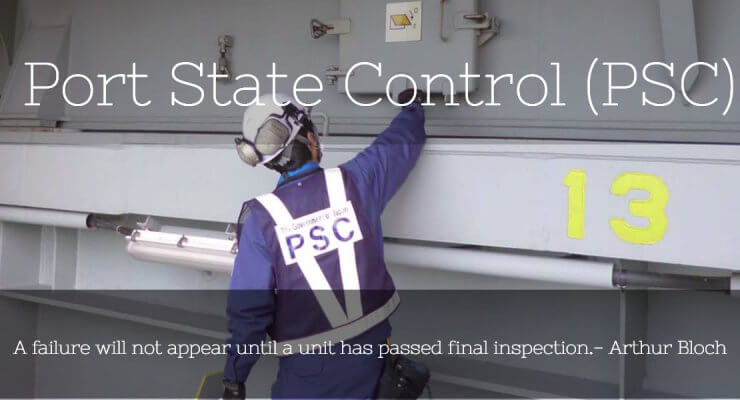
Port State Control (PSC) is the inspection of foreign ships present in a nation's port for the purpose of verifying that the condition of the ships and their equipment comply with the provisions of international conventions and codes and that the ships are manned and operated in compliance with those provisions.Many of IMO's most important technical conventions contain provisions for ships to be inspected when they visit foreign ports to ensure that they meet IMO requirements.These inspections were originally intended to be a back up to flag State implementation, but experience has … [Read more...]

By Cult of Sea Filed Under: Safety Tagged With: code of good practice, detention, equasis, flag state, memorandum, mou, paris mou, port state, port state control, port state control officer, psc, psco

Ship security alert system (SSAS)

ssas

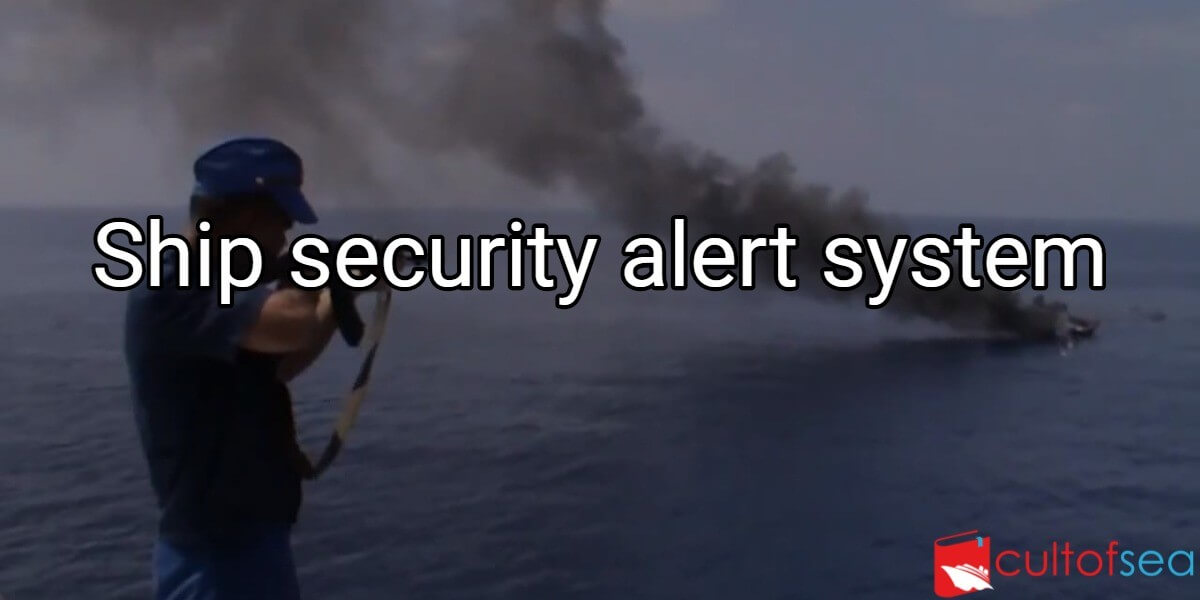
The ship security alert system is again not a GMDSS communications system but it may be associated with GMDSS equipment installed on a ship. Carriage of SSAS is a requirement under theregulations of chapter XI-2 of SOLAS. The ship security alert system is fitted to a ship for the purpose of transmitting a security alert to the shore to indicate to a competent authority that the security of the ship is under threat or has been compromised.SSAS  is a system that contributes to the International Maritime Organization's (IMO)'s efforts to strengthen maritime security and suppress acts … [Read more...]

By Cult of Sea Filed Under: Security Tagged With: administration, coastal state, flag state, gmdss, piracy, rcc, sar, sar region, spoc, ssas, task force

mariner-gps
Sail Time
Simple Colregs COS Ad

Join Our List

Subscribe to our mailing list and get interesting stuff and updates to your email inbox.

Powered with ♥ by Cult of Sea

instagram-button

What others are reading

Double Hull

Types of Double Hull Tankers

TRS Cloud Structure

TRS or a Tropical Revolving Storm

Bridge Navigational Watch Alarm System (BNWAS)

EPIRB

EPIRB – Emergency Position indicating Radio Beacon

Circumpolar bodies

Part A - General

Rule 2 – Responsibility

The Inclining Experiment

The Inclining Experiment – Ascertain the GM of Vessel

intact stability

Intact Stability – Tankers

Cargo Conditioning, Reliquefaction – Gas Tankers

What is Load on Top (LOT)?

LRIT

Long Range Identification and Tracking ( LRIT )

Death On board – Master Responsibility as per MSA 1958

Unclos

UNCLOS – Salient Features, Objectives, Maritime Zones, Passages and Duties

IALA Buoyage System

Part B - Section 2

Rule 11 – Application


About Us | Terms | Contact Us | Sitemap | Marine Glossary (BETA)

Cult of Sea®™ · Made with ❤ by a small band of sailors