Cult of Sea

Maritime Knowledge base

  • Home
  • Knowledge base
    • Bridge Equipment
    • Cargo Work
    • Deck
    • General
    • Gmdss
    • Maritime Law
    • Marpol
    • MLC 2006
    • Meteorology
    • Navigation
    • Safety
    • Security
    • Ship Construction
    • Ship Handling
    • Ship Stability
    • Shippie’s Escape
    • Surveys
    • Tankers
  • Colreg’s (ROR)
    • Index (Colreg’s)
    • Part A- General
      • Rule 1 – Application
      • Rule 2 – Responsibility
      • Rule 3 – General Definitions
    • Part B- Steering and Sailing
      • Section 1 (Rule 4 -10)
        • Rule 4 – Application
        • Rule 5 – Lookout
        • Rule 6 – Safe Speed
        • Rule 7 – Risk of collision
        • Rule 8 – Action to avoid collision
        • Rule 9 – Narrow Channels
        • Rule 10 – Traffic separation schemes
      • Section 2 (Rule 11 – 18)
        • Rule 11 – Application
        • Rule 12 – Sailing vessels
        • Rule13 – Overtaking
        • Rule 14 – Head on situation
        • Rule 15 – Crossing situation
        • Rule 16 – Action by give-way vessel
        • Rule 17 – Action by stand-on vessel
        • Rule 18 – Responsibilities between vessels
      • Section 3 (Rule 19)
        • Rule 19 – Conduct of vessels in restricted visibility
    • Part C- Lights and Shapes
      • Rule 20 – Application
      • Rule 21- Definitions
      • Rule 22 – Visibility of lights
      • Rule 23 – Power-driven vessels underway
      • Rule 24 – Towing and pushing
      • Rule 25 – Sailing vessels underway and vessels under oars
      • Rule 26 – Fishing vessels
      • Rule 27 – Vessels N.U.C or R.A.M
      • Rule 28 – Vessels constrained by their draught
      • Rule 29 – Pilot vessels
      • Rule 30 – Anchored vessels and vessels aground
      • Rule 31 – Seaplanes
    • Part D- Sound and Light Signals
      • Rule 32 – Definitions
      • Rule 33 – Equipment for sound signals
      • Rule 34 – Manoeuvring and warning signals
      • Rule 35 – Sound signals in restricted visibility
      • Rule 36 : Signals to attract attention
      • Rule 37 – Distress signals
    • Part E- Exemptions (Rule 38)
      • Rule 38 – Exemptions
    • Part F – Verification of compliance with the provisions of the Convention
      • Rule 39 – Definitions
      • Rule 40 – Application
      • Rule 41 – Verification of compliance
    • Annexes
      • Annex 1 – Positioning and technical details of lights and shapes
      • ANNEX II – Additional Signals for Fishing Vessels Fishing in Close Proximity
      • ANNEX III – Technical Details of Sound Signal Appliances
      • ANNEX IV – Distress Signals
  • Glossary
  • Contact

The Marine Chronometer

The Marine Chronometer featured image

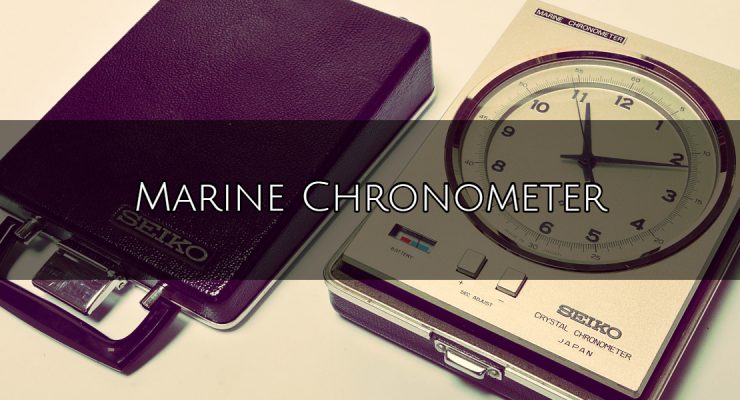
The spring-driven marine chronometer is a precision timepiece used aboard ship to provide accurate time for celestial observations. A chronometer differs from a spring-driven watch principally in that it contains a variable lever device to maintain even pressure on the mainspring, and a special balance designed to compensate for temperature variations.A spring-driven chronometer is set approximately to Greenwich mean time (GMT) and is not reset until the instrument is overhauled and cleaned, usually at three-year intervals.The difference between GMT obtained directly from a radio time … [Read more...]

By Capt. Angad S Cheema Filed Under: Bridge Equipment Tagged With: Chronometer, Marine Chronometer, Quartz crystal marine chronometer, spring driven marine chronometer

mariner-gps
Sail Time
Simple Colregs COS Ad

Join Our List

Subscribe to our mailing list and get interesting stuff and updates to your email inbox.

Powered with ♥ by Cult of Sea

instagram-button

What others are reading

Sart

SART – Performance Standards

Hot work on ships

Hot Work – Definition, Responsibility, Process and Risks On-board Ships

Iron fire

Pyrophoric Iron Fires

ISPS Code

ISPS code – A measure to enhance the security of Ships and Port facilities

Chipping

What is Chipping ? Tools, Precautions & Protection

Certificates Cover

Certificates and Documentation Required to be carried Onboard Ships

GPS (Global Positioning System)

Regulation 15

Control of operational discharge of oil (Machinery Spaces)

Condition Assessment Scheme (CAS)

Condition Assessment Scheme (CAS)

Vegetable, Palm and Soybean/Sunflower Oils – Carriage on Tankers

Flammability

FLAMMABILITY COMPOSITION DIAGRAM

Part B - Section 2

Rule 15 – Crossing situation

alarp risk

What is ALARP and why do you need to know it?

Harmonized System of Survey and Certification

Harmonized System of Survey and Certification (HSSC)

Cargo Conditioning, Reliquefaction – Gas Tankers


About Us | Terms | Contact Us | Sitemap | Marine Glossary (BETA)

Cult of Sea®™ · Made with ❤ by a small band of sailors